
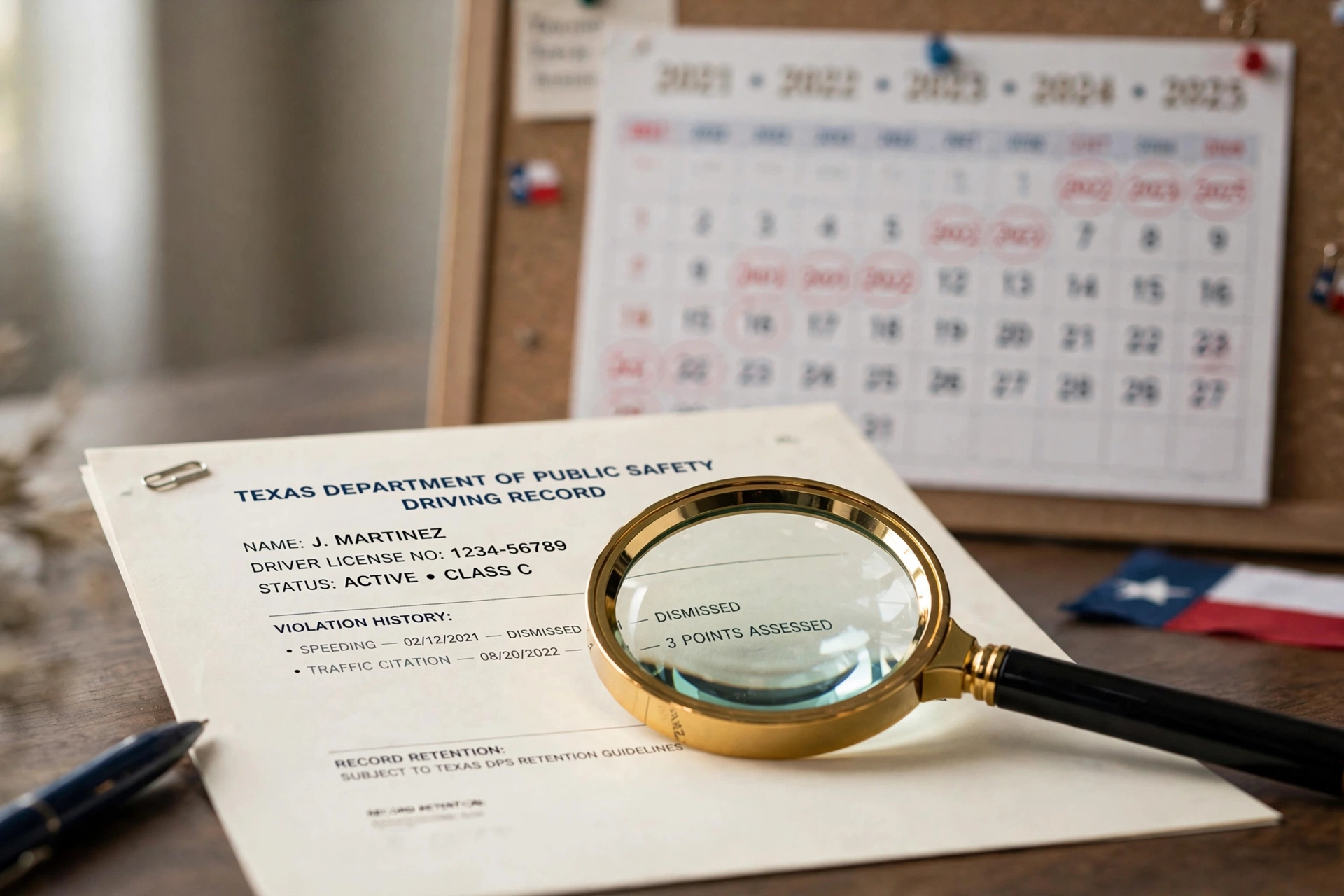
So you got a ticket. Maybe you already paid it, maybe you’re still deciding what to do. Either way, there’s one question probably nagging at you: how long is this thing going to follow me around?
It’s a fair worry. A traffic ticket on your Texas driving record isn’t just a piece of paper — it can affect your insurance rates, show up on background checks, and even cost you job opportunities if you drive for a living. Let’s break down exactly how long tickets stick around in Texas, what “staying on your record” actually means, and — most importantly — what you can do about it.
The Short Answer
In Texas, a traffic conviction typically stays on your driving record for 3 years from the date of conviction. That’s the window during which insurance companies and employers are most likely to see it and hold it against you.
But here’s the thing most drivers don’t realize: “3 years” isn’t the whole story. The ticket itself, the points, and the insurance impact all work on slightly different timelines. Let’s untangle them.
Your Driving Record vs. Points vs. Insurance: Three Different Clocks
1. The driving record (3 years)
When you’re convicted of a moving violation in Texas — whether you paid the fine, were found guilty in court, or pleaded no contest — that conviction goes on your Texas driving record. It stays visible for 3 years from the conviction date. Anyone who pulls your record during that window (an employer, for example) will see it.
2. The Driver Responsibility Program points (3 years)
Texas used to add surcharge points for moving violations under the old Driver Responsibility Program. While that specific surcharge program was repealed in 2019 (good riddance), convictions still appear on your record and can still trigger consequences — including license suspension if you rack up too many.
3. The insurance impact (3–5 years)
This is the one that really hurts your wallet. Most insurance companies look back 3 to 5 years when setting your rates. A single speeding ticket can raise your premium by 20–30%, and you’ll pay that higher rate every year until the violation ages out of the insurer’s lookback window. Do the math on that — it’s often $1,000+ in extra premiums over a few years.
What About Dismissed Tickets?
Here’s the good news: if you get your ticket dismissed through a defensive driving course, it doesn’t go on your record as a conviction in the first place. No conviction means nothing for insurers or employers to find. That’s why dismissal is almost always worth pursuing if you’re eligible — you’re not just avoiding a fine, you’re keeping your record clean for the next 3+ years.
We covered the full dismissal process in our step-by-step Texas ticket dismissal guide if you want the details.
Which Violations Stay Longer?
Not all violations are equal. While a standard speeding ticket ages off in 3 years, more serious offenses stick around much longer:
- Minor moving violations (speeding, running a stop sign): ~3 years
- DWI/DUI: stays on your record permanently in Texas — it never comes off your criminal history, and it affects your driving record for much longer than 3 years
- Reckless driving: treated more seriously than a basic speeding ticket, with longer-lasting consequences
- License suspensions: the underlying violation plus the suspension itself both appear
This is another reason to take even a “minor” ticket seriously — and to dismiss it if you can.
How to Check What’s on Your Texas Driving Record
Don’t guess — look. You can order your own Texas driving record from the Department of Public Safety. The Type 3A certified record is the same one courts ask for, and it’ll show you exactly what’s visible right now: convictions, dates, and any active issues. It costs around $10–15 and it’s the only way to know for sure where you stand.
Pro tip: check your record about 30 days after any dismissal goes through, just to confirm the ticket actually shows as dismissed. Paperwork errors happen more often than you’d think.
Can You Get a Ticket Removed Early?
Honestly? Once a conviction is on your record, there’s no shortcut to erase it before the 3 years are up. Texas doesn’t offer a “record expungement” for traffic convictions the way some states do for criminal records.
But you have two powerful moves:
- Prevent it in the first place — dismiss the ticket through defensive driving before it becomes a conviction. This is the move that actually works.
- Offset the insurance damage — even with a ticket on your record, completing a defensive driving course can earn you an insurance discount of up to 10% for 3 years, which softens the premium hike.
The Real Cost of “Just Paying It”
Let’s say your speeding ticket fine is $200. Feels manageable, right? Now add the insurance increase: roughly $400–600 extra per year for 3 years. Suddenly that $200 ticket actually cost you $1,400–$2,000.
Compare that to dismissal: ~$100–150 in court fees plus a $25 online course. The math isn’t close. Every time.
Frequently Asked Questions
How long does a speeding ticket stay on your record in Texas?
Three years from the date of conviction for a standard moving violation. Insurance companies may look back up to 5 years when setting rates.
Does a dismissed ticket show on your driving record?
If properly dismissed through an approved defensive driving course, the ticket does not appear as a conviction on your record. Always verify by checking your record afterward.
Do points ever come off your Texas license?
Texas repealed its point-based surcharge program in 2019, but convictions still appear on your driving record for 3 years and can still lead to suspensions for repeat violations.
Will one ticket raise my insurance?
Very likely, yes — unless it’s dismissed. A single moving violation typically raises premiums 20–30% at your next renewal, and the increase lasts 3–5 years depending on the insurer.
Can I check my Texas driving record online?
Yes, through the Texas DPS website. Order a Type 3A certified record — it’s the same version courts require, and it shows everything currently visible.
Bottom Line
A Texas traffic ticket follows you for 3 years on your driving record — and costs you at your insurance renewal for up to 5. The only real way to beat the clock is to keep the conviction off your record entirely through dismissal.
Start our $25 TDLR-approved online defensive driving course today — 6 hours at your own pace, 100% online, and the fastest path to keeping your record (and your insurance rates) clean.