
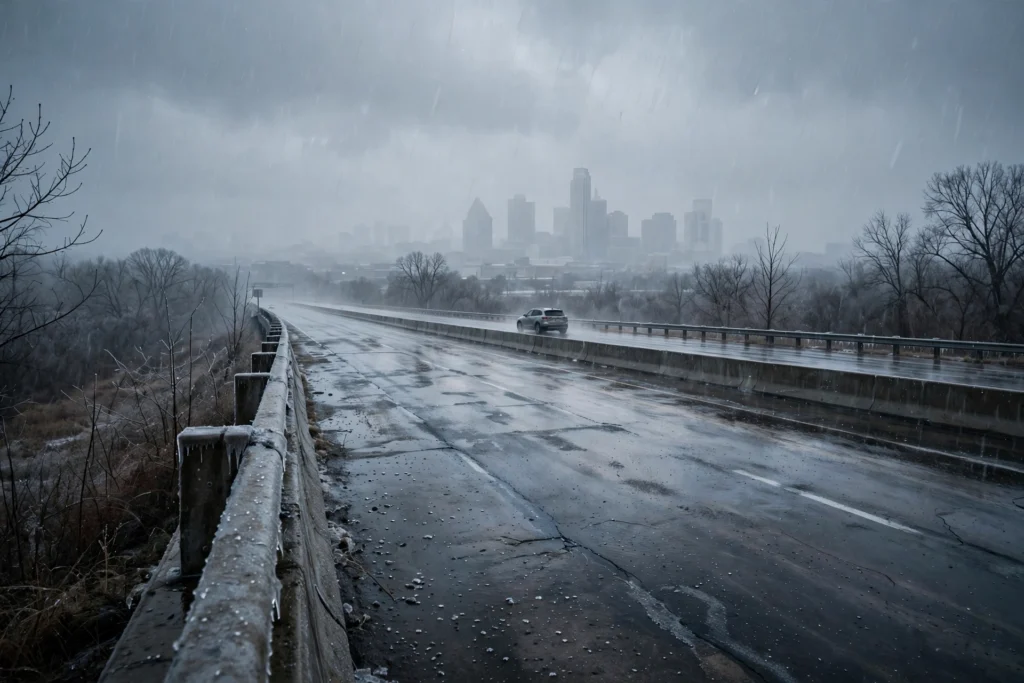
Texas winter driving safety is not about snow tires and snowplows. It is about ice you cannot see, on roads that look perfectly fine, where most drivers have never driven on a frozen highway. Texas gets winter weather rarely enough that every freeze feels like the first one.
Why Texas Winters Catch Drivers Off Guard
Texans do not get much practice on ice. Most of the state sees freezing rain or sleet only a handful of times a year. The National Weather Service puts it bluntly: if the temperature is near freezing, drive like you are on ice, because you may be.
February 2021 showed what happens when that warning is ignored. On February 11, 2021, freezing rain glazed an elevated stretch of I-35W in Fort Worth, and about 130 vehicles piled up, killing six people. The National Transportation Safety Board blamed the buildup of ice on the elevated roadway. The same storm killed 246 Texans in total, 22 of them in road crashes, according to the Texas Department of State Health Services.
What Black Ice Really Is — and Where It Hides
Black ice is a thin, nearly transparent layer of ice on the road. Because you can see the dark pavement through it, it looks like an ordinary wet patch — and drivers discover the truth only when the car stops responding.
It forms most often on bridges, in shaded stretches, at intersections and off-ramps, in the early morning, and anywhere rain is followed by falling temperatures.
Bridges and Overpasses Freeze First
Every Texas driver has seen the sign: “Bridge May Ice in Cold Weather.” A normal road draws warmth from the ground beneath it, but a bridge deck has nothing underneath but cold air, so it loses heat from above and below at the same time. That is why bridges freeze first and stay icy longest.
Slow down before the bridge, not on it. Lift off the gas as you approach and cross at a steady, reduced speed. Keep the wheel straight — do not brake, accelerate or change lanes on a bridge deck in freezing weather.
Freezing Rain, Sleet and Snow: Know What You Are Driving In
Freezing rain is rain that freezes the moment it hits the ground, coating roads in a smooth glaze of ice. The National Weather Service usually issues an Ice Storm Warning when about a quarter inch of ice is expected — enough to make travel dangerous or impossible. It is the most dangerous winter precipitation for Texas drivers.
Sleet freezes into ice pellets before hitting the ground — slippery, but grippier than freezing rain. Snow is rare in Texas and usually melts fast, then refreezes overnight into black ice. The snow itself is rarely the problem. The morning after is.
How to Drive on Ice: Slow Down, Open Up Space, Stay Smooth
Slow down — a lot. Speed limits are set for dry roads. On snow, cut your speed by at least a third. On ice, cut it in half. Texas law requires a speed reasonable for conditions — and ice is the definition of a hazard.
Triple your following distance. Three to four seconds behind the car ahead is the normal standard. On snow and ice, the National Highway Traffic Safety Administration (NHTSA) recommends eight to ten seconds. Stopping distances on ice can be four to ten times longer than on dry pavement; at 30 mph, a stop that takes about 75 feet on dry concrete can take around 750 feet on glare ice.
Turn off cruise control. Cruise control cannot feel the road. On ice it can keep the throttle on while a wheel loses traction, and by the time you react, the car is already sliding. NHTSA is explicit: do not use cruise control on snow-packed or icy roads.
Be smooth with everything. Accelerate gently, brake early and gradually, and steer in small movements. Sudden braking, sharp steering or a heavy foot on the gas will break traction, and on ice you may not get it back.
What to Do If You Skid
Even careful drivers skid on Texas ice — and the first two seconds decide whether it ends as a scare or a crash. Ease off the accelerator — do not slam on the brakes, because hard braking on ice turns a slide into a spin. Look where you want the car to go and steer gently in that direction; if the rear slides out, steer into the skid. If your car has anti-lock brakes (ABS), press the brake firmly and hold it. Do not pump the pedal. Stay calm and do less, not more — panic is what turns a slide into a crash.
Before You Drive: Five Minutes That Can Save Your Trip
Check real-time road conditions on the DriveTexas road conditions map or call 511 before you leave. If TxDOT is reporting ice on your route, change your plans. Clear all the ice off your car — windshield, windows, roof, hood and lights. Check your tires: they lose about 1 psi for every 10°F drop in temperature, and the legal minimum tread of 2/32 of an inch has almost no grip on ice.
Keep an emergency kit in the trunk: a blanket, a flashlight, water, a phone charger, and a bag of sand or kitty litter for traction. During Winter Storm Uri, 69% of Texans lost power for an average of 42 hours. Bad weather does not extend court deadlines, so if you are weighing what a speeding ticket costs in Texas, handle it before the storm, not after.
What TxDOT Does Before a Storm — and What It Cannot Do
When a freeze is forecast, TxDOT crews pre-treat highways with brine, a salt-and-water mixture that works like antifreeze by keeping ice from bonding to the pavement. It is typically applied at 30 to 60 gallons per lane mile in a 23.3 percent solution, and it stays effective down to about -6°F. Before the January 2026 storm, the TxDOT Dallas District had 500+ employees on 12-hour shifts, treating thousands of lane miles, bridges first.
But brine has limits: heavy freezing rain can wash it off, and extreme cold can overwhelm it. No treatment makes an icy road safe — it makes it passable. TxDOT’s message is always the same: if you do not have to drive, do not.
When to Stay Home
Stay home when the National Weather Service has issued an Ice Storm Warning or Winter Storm Warning for your area, when TxDOT or local officials are telling people to stay off the roads, when freezing rain is falling or forecast, when you can see ice on trees, power lines or your windshield, or when your trip is not essential. No meeting, no errand and no shift is worth a crash on black ice. Texas freezes are usually short — one that shuts down San Antonio on Tuesday is often gone by Thursday.
Texas Winter Driving Safety FAQ
Is black ice really invisible?
Almost. It is a thin, transparent sheet of ice that takes on the color of the pavement underneath, so it looks like a wet patch. If it is near freezing and the road looks wet, assume it is ice.
Why do bridges freeze before roads?
A road draws warmth from the ground beneath it. A bridge deck is exposed to cold air above and below, so it loses heat twice as fast and freezes first — and stays icy longer.
Should I use cruise control on icy roads?
No. NHTSA advises against it on snow-packed or icy roads. Cruise control can keep applying throttle when a wheel loses traction, throwing the car into a skid.
What should I do if my car starts to skid on ice?
Ease off the gas, do not slam the brakes, and steer gently where you want the front of the car to go. If your car has ABS, press the brake firmly and hold it — do not pump.
How far behind the car ahead should I stay on ice?
Eight to ten seconds, per NHTSA — roughly triple the normal gap. Stopping distances on ice can be four to ten times longer than on dry pavement.
Stay Safe This Winter — and Sharpen Your Driving
Texas winter driving safety comes down to three habits: slow down, leave room, and stay home when the ice wins.
Want to be a sharper driver in every season? Take our online defensive driving course in Texas. It is TDLR-approved, fully online, and takes about six hours from home. For the other weather hazards Texas drivers face, see our Houston flooding driving guide and West Texas dust storm driving safety guides.
Drive safe, stay warm, and when the ice comes — wait it out.
Sources
- National Weather Service winter driving guidance
- TxDOT brine application guidance
- Texas DSHS February 2021 winter storm deaths report
- NTSB findings on the I-35W Fort Worth pileup
- Texas freeze timeline and damage totals
- NHTSA winter driving tips via Amica
- TxDOT urges drivers to stay home during winter storm
- Black ice, skids and safety tips