
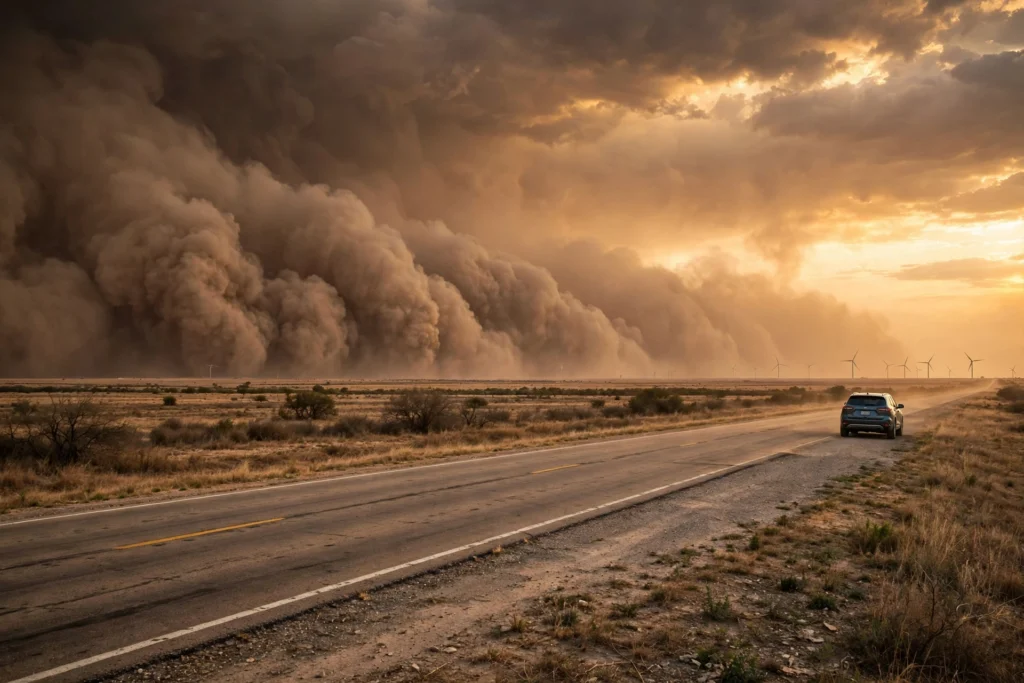
If you drive much in West Texas, you already know the sky can turn brown in minutes. One minute you are cruising down I-20 or US-87 with clear skies, and the next a wall of dust is swallowing the highway ahead of you. Dust storm driving safety in Texas is not a nice-to-know skill out here — it is the difference between getting home and ending up in a pile-up. This guide covers why West Texas gets such violent dust, what the National Weather Service tells drivers to do, and what to check after the storm passes.
Why West Texas Gets Such Bad Dust Storms
West Texas is built for dust. The Panhandle and the Permian Basin sit on dry, open plains where the soil is loose and there is very little to break the wind. In spring, strong weather systems sweep across the region, and when a thunderstorm sends a rush of cold air outward — what meteorologists call outflow winds — that air picks up loose dirt and pushes it forward as a moving wall. That wall is a haboob: a dust storm driven by thunderstorm winds that can be several thousand feet tall and miles wide.
The dangerous part is the speed. Visibility can drop from ten miles to near zero in under a minute. The National Weather Service issues a Dust Storm Warning when it expects visibility of a quarter mile or less, and its alert text carries a slogan every West Texas driver should memorize: “Pull Aside, Stay Alive.” You can read the full guidance on the National Weather Service dust storm safety page.
What a Dust Storm Warning Actually Means
Not every dusty day is a dust storm. Here is how the Weather Service draws the line:
- Dust Storm Warning: visibility of a quarter mile or less is about to strike or has already developed. Wind gusts of 40 to 60 mph are also likely.
- Blowing Dust Advisory: dust cuts visibility to one mile or less, but not below a quarter mile.
- Duration: most dust storms last only a few minutes, though some can go on for up to an hour.
A warning means the danger is already on the road, not on its way. If you are driving toward a brown wall on the horizon, do not try to beat it. Slow down early, and be ready to get off the road completely.
Caught in Dust: Pull Aside, Stay Alive
If you cannot avoid driving into a dust storm, the National Weather Service guidance is simple — and one step surprises almost everyone:
- Pull off the road as far as you can. Get completely off the pavement, not just onto the shoulder. Never stop in a travel lane.
- Turn off all your lights. Headlights, taillights, even your hazard flashers. This is the counterintuitive part: a driver behind you in the dust will steer toward any light they see, thinking it is a moving vehicle. Lights on a parked car have caused rear-end crashes in dust storms.
- Put the vehicle in park and set the parking brake. Then take your foot off the brake pedal so your brake lights are not illuminated.
- Stay in your vehicle, buckled up. Wait for the dust to clear. Most storms pass in minutes.
If there is no safe place to pull off, keep moving at a speed that matches how far ahead you can see, keep your lights on while you are still moving, sound your horn occasionally, and follow the painted center line until you can stop safely. The same “pull over and wait” thinking applies to other weather too — we covered it for flooded roads in our guide to driving in Houston flooding, where the rule is turn around, don’t drown.
High Winds, Big Vehicles and Blowing Debris
Dust is not the only problem on a windy West Texas day. Sustained high winds push hard on high-profile vehicles — box trucks, RVs, trailers and anything towing a load. If you are driving one, slow down before the gusts hit, keep both hands on the wheel, and leave extra space around other vehicles. A sudden gust on an open stretch of I-10 or I-20 can shove a trailer a full lane over.
Wind also throws debris across the road: tumbleweeds, branches, loose gravel and, in the worst storms, pieces of fencing or roofing. Before a long drive, check conditions on TxDOT’s DriveTexas road conditions map, which shows closures, high-wind warnings and construction zones across the state. Work zones are a separate hazard in high wind — loose signs and barriers move around, and fines double there, as we explained in our I-35 Waco work zone rules and fines guide.
After the Storm Passes
Once the dust clears, do not just floor it. A few things are worth checking:
- Visibility can stay low. Dust hangs in the air after the main wall passes, and a second gust can bring it back.
- The road may be covered. Sand and dirt on the pavement cut your grip, and debris can be hiding in it.
- Check your car. Dust gets into air filters and can clog them. If your engine sounds rough or your air conditioning smells dusty, get the filter checked.
- If you were in a crash, exchange information as usual and report it. A dust storm does not erase fault — and a ticket from the incident can still follow you.
Frequently Asked Questions
How fast can visibility drop in a dust storm?
From ten miles to near zero in under a minute. That is why the Weather Service warns drivers to pull off the road before the wall reaches them, not after.
Should I turn my hazard lights on in a dust storm?
No — not once you are parked off the road. Turn off all lights, including flashers, so drivers behind you do not follow your lights and hit your parked car. Keep lights on only while you are still moving and looking for a place to stop.
What is a haboob?
A haboob is an intense dust storm pushed forward by thunderstorm outflow winds. It looks like a solid brown wall, can be thousands of feet tall, and arrives fast enough that drivers have almost no warning.
Is it illegal to drive through a dust storm in Texas?
There is no law that says “do not drive in dust,” but Texas law requires a speed that is reasonable and prudent for conditions. Driving 75 mph into zero visibility is not reasonable, and it can earn you a ticket — or worse.
How long do dust storms usually last?
Most last only a few minutes, though some go on for up to an hour. Pulling over and waiting is almost always the fastest way through one.
West Texas weather does not give much warning, but it does give you a choice: pull aside and wait it out, or gamble with zero visibility. The right choice takes five minutes. The wrong one can take a lot longer.
Ticket mila hai? Amarillo court mein defensive driving ki request ka tareeqa dekhein.
And if a ticket does land on your record, our online defensive driving course in Texas can help you dismiss it for $25 — TDLR-approved and done entirely online.