 Skip to content


License points are a state tool: the DMV or licensing agency adds them to your record after a conviction, and enough of them can cost you your license. Insurance points are an insurer’s own scoring of your record to set your price. In Texas the first kind no longer exists for ordinary moving violations, but the second kind still shapes your premium. This guide explains the difference and shows what a Texas driver can do about a ticket before it becomes a conviction.
TL;DR
- License points belong to the state and can lead to suspension. Insurance points are a private pricing tool, and each company sets its own rules.
- Texas repealed the Driver Responsibility Program in 2019, so DPS no longer assesses points for moving violations.
- A conviction can still raise your insurance cost and, if you stack up enough of them, can still threaten your license.
- If you are eligible and the court approves, completing a defensive driving course can get a ticket dismissed instead of becoming a conviction. Our TDLR-approved online course costs $25.
Table of Contents
- License points and insurance points: the core difference
- What Texas does with license points
- What insurance points really are
- How long a ticket can follow you
- Can tickets make you uninsurable?
- The best fix: keep the ticket from becoming a conviction
- A worked example
- Insurance discounts are a separate benefit
- Perspective
- Ready to deal with your ticket?
- FAQ
- Sources
License points and insurance points: the core difference
People use “points” for two separate scoreboards, and most of the confusion online comes from mixing them up. Many of the pages that rank for this topic come from states like North Carolina, where both systems really exist side by side. Texas works differently, so it helps to define both terms first.
| License points | Insurance points | |
|---|---|---|
| Who keeps score | The state licensing agency | Your insurance company |
| What they decide | Whether your license is suspended or revoked | How much you pay, or whether you are offered coverage |
| Who sets the rules | State law | Each insurer, within what state law allows |
| Can you see them | On your official driving record | Usually not as a number; you see them as a price change |
| Texas status | No point system for moving violations | Still in play, as rate factors |
An insurer does not need your state to assign points. It looks at your record, your claims and other rating factors, then applies its own scoring. The state’s system and the insurer’s system can agree, but nothing forces them to.
What Texas does with license points
In the past, Texas ran a program that assessed points and surcharges. The Texas Department of Public Safety says the Driver Responsibility Program was repealed, that DPS no longer assesses points for moving violations, and that previously assessed points were removed.
That does not mean tickets are free of consequences for your license. DPS states that a license may be suspended after conviction of four or more moving violations within 12 months, or seven or more within 24 months. So Texas counts convictions rather than assigning point values to each type of offense.
In practice:
- A single ticket will not put your license at risk by itself.
- The risk comes from repeated convictions in a short window.
- A dismissed ticket is not a conviction, which is why dismissal matters so much (more on that below).
What insurance points really are
Insurance “points” are not a legal term in Texas. They are shorthand for the weight an insurer gives to violations and accidents when deciding your rate. The Texas Office of Public Insurance Counsel explains that traffic violations, at-fault accidents and paid claims can increase car insurance costs, and that the size of the increase may depend on how severe and how many incidents there are, and varies by company.
Your driving record is only one input. The Texas Department of Insurance notes that premiums rest on many variables, including vehicle usage, location, credit-based insurance scores and claims history, in addition to your record. That is why two neighbors with the same ticket can see different changes at renewal.
TDI also makes clear that it does not set rates or premiums, though its actuaries review rate filings to check that changes are supported and follow state law. There is no single statewide table that says “speeding equals this many points.”
Where the law does set a rule
A few rules do apply. A 2010 TDI bulletin says insurers other than county mutuals may not assign rate consequences to charges or convictions for certain Transportation Code violations (Subtitle C, Title 7, the rules of the road). State law also requires insurers to apply a surcharge for no more than three years after convictions under Penal Code Sections 49.04, 49.07 or 49.08, the intoxication-related offenses.
Those provisions are narrow and technical, and how they apply to a particular policy depends on the insurer and the policy type. If you want to know how a specific ticket affected your rate, your insurance agent or the company can tell you, and TDI’s consumer line can help if something looks wrong.
How long a ticket can follow you
Two clocks run after a conviction, and they are not the same.
- The state record. Your driving record shows violations and accidents. Texas drivers can order a driver record online through DPS, which is the best way to see exactly what the state has on file.
- The insurer’s lookback. Insurance companies set their own guidelines for how long they charge higher premiums for citations. One company may look back three years, another a different period.
The practical effect is that a ticket can stop mattering to your license long before it stops mattering to your premium, or the other way around. Ask your insurer about its lookback rather than assuming.
Timing at renewal matters too. TDI explains that an insurer has a 60-day period after issuing a policy to do further underwriting research, during which it may change premiums or cancel the policy based on newly discovered information. A fresh conviction showing up on a record check in that window can matter.
Can tickets make you uninsurable?
Usually not from one ticket. TDI’s consumer FAQ says companies probably will not drop you after a first wreck, but many accidents or tickets might mean higher charges. If two or more companies turn you down, your agent can arrange a basic policy through TAIPA, the Texas Automobile Insurance Plan Association.
That is a safety net, not a goal. Keeping your record clean keeps more companies willing to quote you at standard rates.
The best fix: keep the ticket from becoming a conviction
Both license consequences and insurance consequences usually follow a conviction. So the cheapest moment to act is before the ticket is resolved. In Texas, many courts allow eligible drivers to take a defensive driving course, officially a driving safety course, in exchange for dismissal.
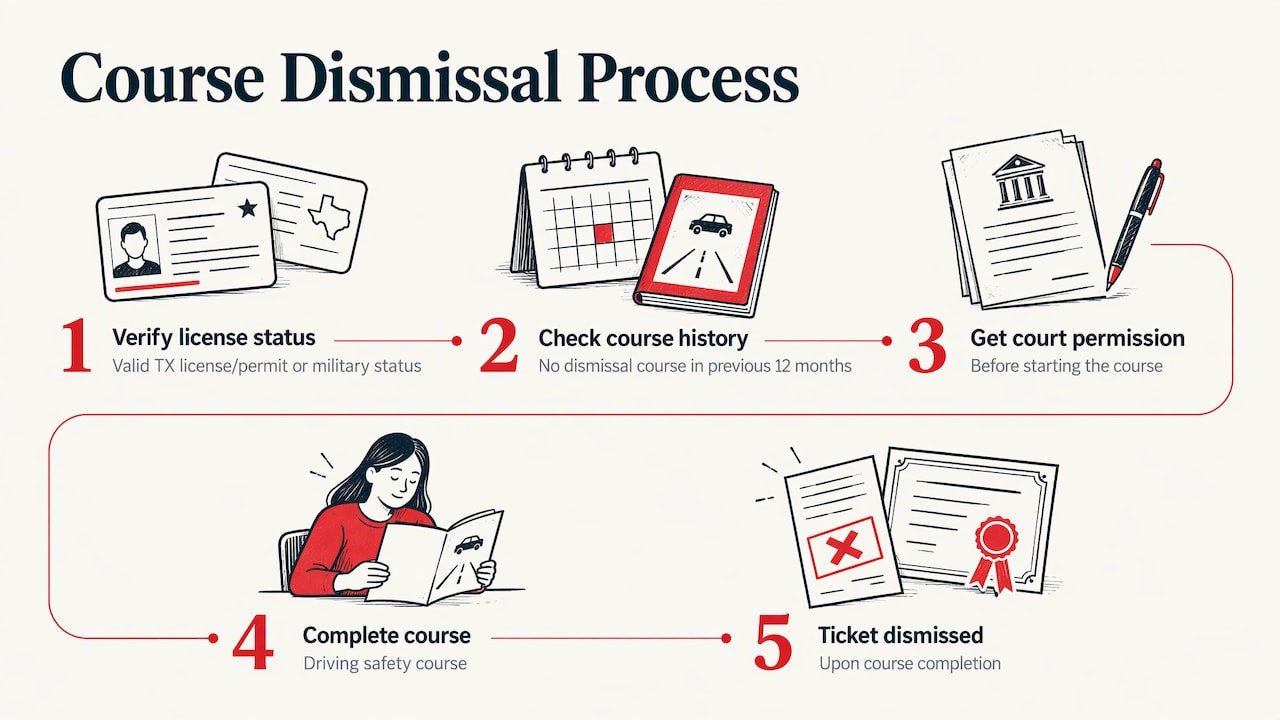
The details come from your court, but a city example shows the pattern. The Town of Double Oak says that upon completing the course, the violation will be dismissed. It also lists requirements: you must get court permission before starting, hold a valid Texas license or permit (or have military status), and not have taken a ticket-dismissal course in the previous 12 months. Other courts have their own paperwork and deadlines, so treat your citation and your court’s instructions as the final word.
A simple order of operations
- Read the citation for the court name, the deadline and the answer options.
- Contact the court, or use its website, to ask whether you are eligible for a driving safety course and what it must receive.
- Request permission before you start the course if the court requires it.
- Complete a TDLR-approved course.
- Submit the certificate and any other documents the court asks for before the deadline.
- Confirm in writing, or on the court’s site, that the case is dismissed.
Some courts ask for a certified driving record along with the certificate. DPS says a Type 3A certified list of all accidents and violations is acceptable for a defensive driving course. We offer a Texas Type 3A driving record request for drivers who need one, so ask your court first whether it is required.
A worked example
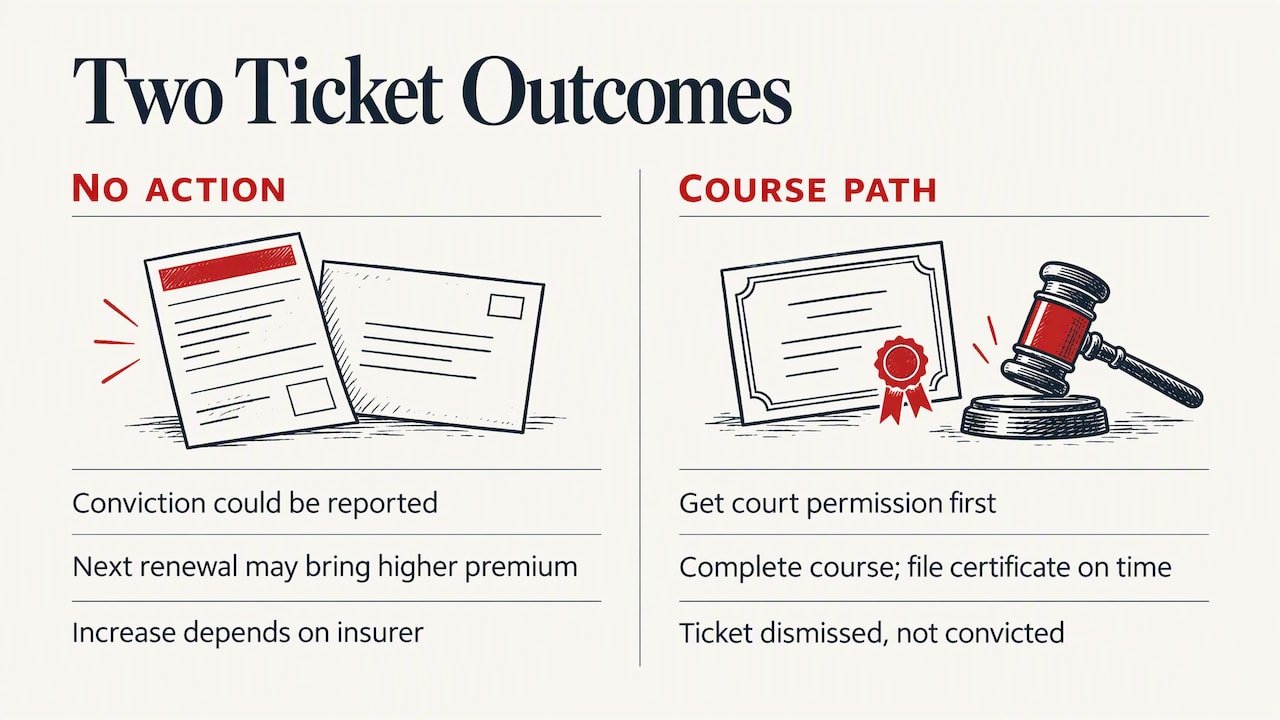
Say a driver gets a speeding ticket in a Texas city and has not taken a dismissal course in the last year. Without action, a conviction could be reported, and the next renewal could bring a higher premium, by an amount that depends entirely on the insurer. If the court allows a course, the driver gets permission, completes it and files the certificate in time, then the ticket is dismissed rather than convicted. We cannot promise any particular rate result, because each insurer decides its own pricing. But a dismissed ticket does not add a conviction to the record, and that is the one thing within your control.
Insurance discounts are a separate benefit
Ticket dismissal and insurance discounts are two different uses of the same kind of course. TDI says insurers often give premium discounts to policyholders who successfully complete a defensive driving or driver education course, but the terms are set by each insurer. Before you sign up, ask your company whether it offers a discount, which courses it accepts, how long the discount lasts and what proof it needs.
Perspective
Every week drivers ask us whether a ticket will “put points” on them. The honest answer in Texas is that the state’s point program is gone, but the word has stuck because insurers still score tickets in their own way. That is exactly why we built our course around the moment that matters: before the conviction.
We designed the course to be easy to finish. It is fully online and self-paced, there is no final exam, and many learners finish in as little as six hours and receive their certificate the same day. Support is available 24/7, and the course comes in English and Spanish, because a ticket does not wait for a convenient schedule.
Our view is simple: check your eligibility with the court, get permission if it is required, and use a TDLR-approved course so your effort counts. For $25, it is a small step toward keeping a ticket off your record and your insurer’s file.
the author
Ready to deal with your ticket?
If your court allows a driving safety course, our TDLR-approved Texas defensive driving course costs $25. You can take it from home at your own pace, with no final exam, and over 50,000 Texas drivers have used our service.

Choose the English or Spanish version, and reach out to our support team any time if you are unsure what your court needs. Check your court’s permission and deadline first, then enroll.
FAQ
Does Texas put points on my license for a speeding ticket?
No. DPS says the Driver Responsibility Program was repealed and that it no longer assesses points for moving violations. A conviction still appears on your record, and enough convictions in a short period can lead to suspension.
Will a ticket raise my insurance if there are no license points?
It can. Insurers consider violations and accidents when setting rates, and each company decides how much a conviction counts and for how long. A ticket that is dismissed through a defensive driving course is not a conviction, though you should confirm with your insurer how it treats your situation.
How many tickets can I have before my Texas license is suspended?
DPS says a license may be suspended after four or more moving violation convictions within 12 months, or seven or more within 24 months. Dismissed tickets are not convictions, so they do not count toward those totals.
Can I take defensive driving every time I get a ticket?
No. Courts set eligibility rules, and one example, Double Oak, requires that you have not completed a dismissal course in the previous 12 months. Ask your court about its exact rule and whether it needs to approve the course before you start.
How do I see what is on my driving record?
You can order your record online through the Texas Department of Public Safety. If your court asks for a certified list of accidents and violations, a Type 3A record is the type DPS says is acceptable for a defensive driving course.
Sources
- Driver Responsibility Program Surcharge Repeal FAQs, Texas DPS
- Traffic Offenses, Texas DPS
- How is My Car Insurance Rate Calculated?, Texas OPIC
- Auto and home policy underwriting, Texas Department of Insurance
- How are your auto and homeowners insurance costs calculated?, TDI
- Bulletin B-0047-10, TDI
- Texas Insurance Code statutes
- Driver’s License Points by State, FindLaw
- How to Order a Driver Record, Texas DPS
- Driver record types, Texas DPS
- Driving Safety Course, Town of Double Oak
- FAQ: Auto insurance, claims, coverage issues, TDI
