
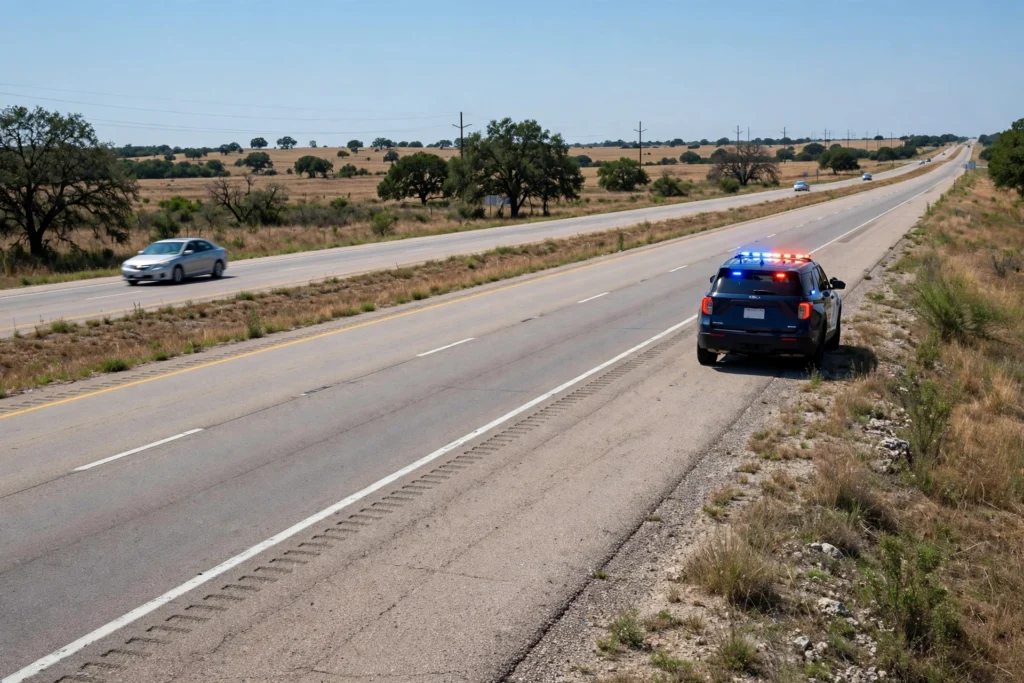
You are driving down a Texas highway and ahead, on the shoulder, a vehicle sits with its lights flashing. A police car, a tow truck, a TxDOT crew — someone is working inches from traffic. What Texas law expects from you in that moment is simple, and getting it wrong is expensive.
It is called the Move Over or Slow Down law, Texas Transportation Code § 545.157. When you approach certain stopped vehicles with activated warning lights, you must do one of two things: move over a full lane away from the stopped vehicle, or slow down.
Move over, or slow down — exactly what that means
On a road with two or more lanes in your direction, vacate the lane closest to the stopped vehicle — but only when you can change lanes safely. A lane change that cuts someone off is not what the law asks for; the duty to change lanes only when safe still applies.
If you cannot move over safely, or the road has only one lane your way, slow down: to 20 mph below the posted speed limit. On a road posted at 25 mph or less, slow to 5 mph. That is TxDOT’s own summary of the rule.
The point is a buffer. Roadside workers have no protection except the space drivers give them, and a car passing at full highway speed a few feet away leaves no room for error.
Which vehicles are covered — and what changed on September 1, 2025
The law covers stopped vehicles with activated overhead or warning lights, including law enforcement, fire and EMS, tow trucks, utility service vehicles, municipal waste trucks, TxDOT and highway work vehicles, and toll project vehicles.
Since September 1, 2025, it covers more. Senate Bill 305 (Sen. Perry, signed May 20, 2025) expanded the law to vehicles driven by animal control officers and parking enforcement employees when their visual signals are on. So the flashing lights that trigger the duty are no longer only red and blue, or only amber tow lights — any covered vehicle with its warning lights activated counts. If you see flashing lights on the shoulder, treat it as a move-over situation first and sort out the vehicle type second.
Source: TxDOT, Move Over or Slow Down
Source: S.B. 305 bill analysis (effective September 1, 2025)
What a violation costs
TxDOT states that failing to follow the law can result in a fine of up to $1,250 for a first offense. Other current summaries of § 545.157 put the first-offense fine range at $500 to $1,250, with higher fines for repeat offenses. If a violation causes bodily injury to another person, it becomes a Class A misdemeanor, and TxDOT notes drivers who cause serious injuries may face jail time and a fine of up to $4,000. Older fine figures still floating around online (for example $200) are outdated — do not rely on them.
A ticket here is also a record problem, not just a fine. In Texas, paying a traffic fine can mean accepting a conviction that stays on your driving record and can affect insurance rates. Before paying any ticket, check your court deadline and whether your court will allow defensive driving for your violation — your court decides, and not every violation qualifies.
For many eligible Texas tickets, a TDLR-approved 6-hour online defensive driving course — ours is $25 — can lead to dismissal once you have court permission and submit your certificate on time.
A habit that covers every case
You do not need to memorize the covered-vehicle list while driving. Use one rule: flashing lights on the shoulder means move over a full lane if you safely can, otherwise slow down 20 mph below the limit (5 mph on low-speed roads). It protects the person on the roadside, and it keeps you out of a $1,250 fine. The same instinct helps in work zones — see the I-35 Waco work-zone rules.
FAQ
What does the Texas Move Over law require?
Move over a full lane away from a stopped vehicle with activated warning lights, when you can do so safely. If you cannot move over, slow to 20 mph below the posted speed limit — or to 5 mph on roads posted at 25 mph or less.
Which vehicles does the Texas Move Over law cover?
Law enforcement, fire and EMS, tow trucks, utility vehicles, municipal waste trucks, TxDOT and highway work vehicles, and toll project vehicles with activated lights — plus, since September 1, 2025, animal control and parking enforcement vehicles.
What changed in the Texas Move Over law on September 1, 2025?
Senate Bill 305 expanded the law to vehicles driven by animal control officers and parking enforcement employees using visual signals. The move-over-or-slow-down duty itself did not change.
How much is the fine for violating the Texas Move Over law?
TxDOT states a fine of up to $1,250 for a first offense; current summaries of § 545.157 put the first-offense range at $500 to $1,250. If the violation causes bodily injury, it becomes a Class A misdemeanor, with possible jail time and a fine of up to $4,000.
Can defensive driving dismiss a Move Over ticket in Texas?
It depends on your court and your violation. Many eligible Texas tickets can be dismissed with a TDLR-approved defensive driving course, but your court must approve first. Check with your court before enrolling — do not pay the fine first and assume dismissal follows.
CTA + disclaimer
Enroll now — $25 TDLR-approved course
This post is general information, not legal advice. Fines and court rules can change; always confirm deadlines and requirements with your court, and check TxDOT’s Move Over or Slow Down page for the latest summary.